Digital transformation is an ongoing process—there is no end date! It’s the coming together of three prior separate systems, AI driven automation, Cloud driven SaaS and Lean & high performing Web delivery, and their operation on one business operating system. Businesses that manage them as three different aspects agree on three different budgets, duplicate resources, and even have a web presence that detracts from all that the back-end team has created. The ones that do are thinking of the AI / SaaS / web technology stack as the unified stack to optimize for: a frictionless gap between an idea and an execution – at every point and for every person, internal or external.
The first pillar of the Empire is to orchestrate the AI and SaaS Stack.
Most enterprises already have in place 20-60 SaaS tools. Instead of more, it’s about how to bridge them with each other to enable data transfer without manual copy-paste from screen to screen. With all your data, flows and processes automated on an API-first base, your old CRM digital tools, finance system, support desk and marketing platform become a single pipeline instead of 6 different data silos creating their own version of the truth.

The reason for this is AI needs to be a part of the workflow—rather than sitting aside from it. They are not “innovation projects” like predictive analytics models which can identify potential customer churn before a renewal call AND route engines that can determine which types of support tickets based on historical trends yield the fastest resolutions approach to enterprise digital transformation, and forecasting models that can also anticipate stockout before it occurs. They are infrastructure, and they really only function when the infrastructure that feeds them with the data is clean and the APIs between each other SaaS is stable, well defined and thriced on.
The real problem in most companies doesn’t lie with having too few tools that are based AI systems. It’s brittle integration. If a predictive model is based on outdated, redundant and/or disconnected data, then it will be able to provide “confident but wrong answers”—which can be worse than no model at all. The integration layer prior to layered AI on top of a SaaS stack must be solid and consist of consistent data schemas, authenticated API connections and a clear system of record for each type of data. If so, scaling depends on adding new endpoints, rather than on creating new pipelines each time that the number of people (or transactions) grows by double.
All of this needs to be built upon and not around zero trust security like BotSpace. Each API connection between SaaS is a possible access point, as is each artificial intelligence model accessing customer information and each integration. With a stack this interconnected, there’s only one way to achieve per-request verification, which is based on identity. What legacy retirement is most of all is a security decision; why legacy retirement systems need to be replaced with those that can support both token based authentication and granular permissioning is so that no one has to assume the lowest common denominator in the security architecture.
Pillar II: Modern vs. Modernized Front-Ends and legacy Web Architecture
All of that effort to optimise your internal system can be done and then undone by your one real customer, investor and job seeker site: your public site. Slow, bloated and cumbersome to use, and dependent on the use of plugins, your web platform is a legacy system, just like an ERP, TechGropse that hasn’t been patched the same as one runs your brand’s first impression.
Beforehand Legacy Web Platforms
Legacy Style, modernized Frameworks: (e.g., Templateiki) Lightweight, pre-optimized code structures are optimized for sub-second response times and typically pass Core Web Vitals thresholds without any manual tuning, bloated CMS cores, render-blocking scripts or a lot of plugins. Dedicated dev-ops time and continual security budget are needed for constant patching and plugin vulnerabilities, as well as server-side dependencies
Minimal-dependency architecture and static deployment drastically reduce the attack surface, eliminate a security patch cycle and dependency on plugins that needs to be managed at server level
Mobile Responsiveness & User Experience: May be retrofitted for mobile after building from the “template” layer first, rather than promoting responsive behavior of customer relationship management tracked throughout the layers leading to the end product. May have responsive behavior built into coding framework to reflect mobile-first design process, but it can also be added later using a retrofitting process.
Recurring Operation Cost: Ongoing hosting fees and developer retainers like digital publishing platform as per the licenses obtained are part of the costs of operation. Infrastructure related cost is minimal and there are no recurring developers’ retainers – infrastructure almost free and high performance
Business as usual with each row — integration with legacy web platforms is one area of ‘easy’ but failure to function effectively is another. That that same discipline for the external Web presence with a modernized framework eliminates the drag that would exist at the architecture layer, is why it aligns itself with the same degree of discipline in terms of modernization that other legacy applications like ERP, or the on-prem data center might have.
Insufficient on-field business execution steps by business leaders is playing the role of Pillar III.
Pillar III is inadequate tactical execution steps by business leaders.
If transformation roadmap remains abstract, it doesn’t work. This is the sequence it’s really going to execute and that’s how it’s going to be done.
1. Prior to touching anything all the way check the full stack. Now, inventory all your SaaS tools, all AI processes over on-premises vs cloud and all other web infrastructure that your business uses from the outside, such as the corporate blog, content hubs, or any customer facing portal. Have you ever been surprised by how ‘outdated’ your public web assets have been in comparison to internal stack modernization, which may have happened twice in the last few years?
2. Infra reconstruction must be done first. Create standard API connections before introducing new AI tools with the existing SaaS applications. It’s unsophisticated work, but one that makes a big difference with an AI rollout that goes scaled and one that is forced to be re-architected after 6 months.
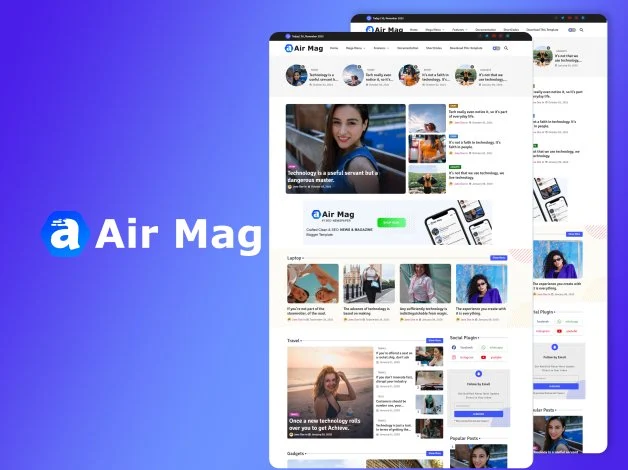
3. Bring external content and blogs up-to-date. This is the aspect of your brand that all leadership teams fail to invest in and the aspect that allows your brand to have the look it deserves, for the work you have on the inside. Templateiki offers the opportunity to move corporate blogs and content portals to highly efficient servers like N8n Automation, which are not slowed down by the bloat of legacy CMS platforms – or by the use of plugins. Pre-optimized templates, like our SEO-friendly content news hub template Air mag or ad-heavy blog template Light Spot, provide mobile rendering out of the box, as well as clear ad placement zones that are AdSense ready, and a well-designed content hub that is optimized to be found by search engines from day 1 without any dev sprint needed to get there. This is not a design refresh, but infrastructure projects, and should be done in parallel to SaaS integration efforts like social media automation, NOT as a marketing add-on.
4. Add AI-powered automation and constantly keep track of. When the integration layer, and the public web foundation are stable, deploy the predictive tools and automation services against the two. Have 90-day review cycles to find “integration drift,” security holes, and trouble spots before they build upon themselves like multi-vendor marketplaces.
Since the knowledge is continuously changing, it is necessary to develop a zero overhead knowledge architecture.
Technical debt does NOT come with an invoice. Its presence manifests itself as an inability to cancel the developer retainer, a cloud email security patch you can’t refuse and a website gradually slowing down the more often you aren’t doing something to it every quarter month.
Often, the critical documentation centers or resource hubs will be the most heavily trafficked assets of a company’s stack that fall toward the bottom of the priority list for any developer — they are essential for customer self-service and SEO, but don’t always receive the attention and resources of a developer that they deserve. It’s here that the framework selection becomes important – more so than pretty much anywhere else in the stack. These documentation hubs or knowledge bases can be hosted on a secure, maintenance-free system (like Nikk UI theme or other free templates from Templateiki) to allow them to withstand real traffic without having to hire a standing development team or paying for a recurring security patch schedule. Its independence is impressive: you don’t need to maintain an entire knowledge base as part of your budget, this means it can be used to invest in AI or SaaS final finishing jobs that will actually propel your business forward.
The Transformation Imperative
When the invisible becomes as much a part of the equation – when data pipelines are scrubbed and clean, APIs are connected seamlessly and zero-trust access control is in place – the public web presence sets up for success, loading lightning fast, protecting itself and never requiring the presence of a developer to keep going. If the companies continue with their old system on the outside, but with modernized in-house automation systems, they may only be 50% mechanized and that 50% is exposed where they interact with their customers and prospects for the first time. Consider the AI stack, integration as SaaS, and public web foundation as one system, with shared funding and review: the ops speed you’re creating internally will actually hit the market – not doorstop.